A View of Jacksonville from a Competitor

Florida Trend asked an economic development professional in a market that competes with Jacksonville to assess the citys strengths and weaknesses.
Quote
Strengths:
Jacksonville has been linked to a great sea by a great river since its beginning days. With the widening of the Panama Canal, scheduled for completion in 2014, Jacksonville is poised to assume an even more powerful leadership role in the coming era of giant cargo ships. But its greatest strength is its model of government, created in 1968. Jacksonville is today the envy of civic, business and governmental leaders from across our state, since its one-stop-style-of-local-government makes doing things in Jacksonville easy when compared to most other cities and counties in Florida.
Weaknesses:
"Although it is the largest city in our state by size, when contrasted to and when competing with other regions of Florida, Jacksonville has a comparatively small population. As a result, it lacks some of the amenities and the quality of life image now being demanded by the creative class. In the years ahead, Jacksonville will have to learn how to better showcase its assets; not just to future residents now living in other parts of the United States, but to those citizens looking to relocate to the United States from other countries. This international competition for talent is going to be an especially difficult game for Jacksonville to win, unless it establishes new ways of recruiting highly skilled, highly educated, highly motivated workers, essential for the new economy.
Source: http://www.floridatrend.com/article.asp?page=1&aID=51436
Impact of Transportation on 21st-Century Economic Development
Quote
Growing numbers of creative workers will no longer tolerate time-wasting commutes. In a massive national survey of information technology workers by InformationWeek, commuting distance was ranked among the most important job attributes by about 20% of respondents -- outscoring items such as bonus opportunities and financial stability of the firm. Regions that find ways to cut their time overhead may well enjoy a competitive advantage in the future.
Because of the need for people to save time, rebuilding and improving public transit must be a priority...
Source: Cities and the Creative Class by Richard Florida
Historically, when we speak "transportation and logistics" in Jacksonville, the conversation ends up dominated by focus on port-related and road construction projects at the expense of pedestrian, bicycle and mass transit needs. If we look at the world outside of Northeast Florida, we will discover that these alternative forms of mobility play an important role in attracting the type of jobs and skilled workforce needed for them. With that in mind, any discussion of "transportation and logistics" locally must include a real effort to transform our city into a multimodal-friendly community.
1. Streetcar & Commuter Rail Planning

Charlotte's 9.6-mile LYNX Blue Line has generated $1.87 billion in development since the city officially announced its intentions to bring LRT to the community.
According to the American Public Transportation Association (APTA), every $1 spent on public transit projects generates, on average, $6 in local economic activity. For example, Portland's streetcar line generated $2.8 billion in private-sector investment between 1997 and 2005. Within five years of its opening, Dallas DART light rail system has generated $3.3 billion in private investment, 32,000 jobs, and 39-53% greater growth in property value than elsewhere in the city.
So what comes first? Density or rail? These examples ( http://www.metrojacksonville.com/article/2010-jun-before-after-rail-spurs-economic-development ) suggest that rail stimulates the type of sustainable, job-producing economic developmental success that we seek in our struggling neighborhoods. Luckily for Jacksonville, the recent approval of the 2030 Mobility Plan and Fee has given us a funding mechanism for starter commuter rail and streetcar lines that could be operational by Alvin Brown's second term. With this in mind, its time to immediately move forward with the marketing, promotion, and planning of these systems in an effort to reap in the economic benefits that peer cities like Austin and Charlotte have enjoyed before their systems began physical operation.

Although the Mobility Plan's initial streetcar line may be a few years away from operating, there's no reason why openly promoting, marketing, and planning for it can't bring economic development to neighborhoods like Brooklyn right now.
2. JRTC Redesign

JTA's current inefficient, budget busting and land consuming intermodal center concept.
Downtown Jacksonville hasn't been the same since the Haydon Burns Administration ripped its organic, logistical economic structure to shreads a half century ago. Currently, JTA has plans to bring passenger rail back to downtown in the form of the Jacksonville Regional Transportation Center (JRTC). Clustering complementing uses within a pedestrian-friendly compact setting is the key to downtown revitalization. However, spanning over eight city blocks and designed around a convention center that could be gone before the center is fully completed, this $180 million behemoth is anything but compact. If we're truly interested in having a usable intermodal facility that spurs ancillary private-sector economic development, while not being an operational nightmare, compact redesign is a must.

With JEDC's plans to donate additional city property for the JRTC, spread-out components like the proposed Greyhound bus terminal could easily be redesigned/relocated, creating a more compact and transit-user-friendly facility in the process. Additional blocks gained by a more compact transit center will give the city the opportunity to attract private-sector, property-tax-paying ancillary development.
3. Creating A Bike Network Through Street Repaving/stripping Projects

Art Museum Drive near Beach Boulevard; The lack of pedestrian and bicycle facilities on several of our streets creates a dangerous environment for anyone not behind the wheel of a vehicle.
According to a recently released report from the Surface Transportation Policy Partnership and Transportation for America, Jacksonville ranks as the fourth most dangerous city for pedestrians in the United States. The primary reason? The continued investment of roadway projects that are designed for automobiles and trucks at the expense of pedestrians and cyclists. Strangely, the majority of our newer suburban roads have been designed to contain bike facilities while the urban core (where alternative forms of transportation usage is much higher) remains severely limited. The result is a city with a disconnected pedestrian/bike network, negatively characterized by its high pedestrian/bicyclist death rate. Not good if you want to attract the highly skilled, quality-of-life-seeking workforce needed to work the jobs we would like to see stimulated locally. Luckily, the urban core's streets tend to be much wider than their suburban counterparts and COJ Public Works resurfaces them on a routine basis. Properly coordinated, our core city's pedestrian and bicycle networks can be improved by including them as part of already-funded roadway maintenance projects, giving our urban neighborhoods the economic opportunities that come with being multimodal-friendly communities.

This New Orleans Warehouse District image illustrates how resurfacing streets can be used as an opportunity to improve the city's bicycle network's connectivity and safety.
4. Street Trees

The intersection of San Juan and Blanding is an example of how an established Jacksonville commercial corridor could be enhanced with the addition of street trees.
Although overlooked, many of Jacksonville's neighborhoods are blessed to have commercial centers that are either already walkable or with minor enhancements, could greatly improve the pedestrian experience. In the long run, this reduces the need for major roadway projects and the long-term public subsidization that accompanies them. Nevertheless, one of the most important ingredients in revitalizing dated commercial districts and encouraging walkability, is the inclusion of street trees. Traditionally, there were either awnings or a tree canopy to protect pedestrians from the sun, frequent rain, or thunderstorm activity. Without street trees, extreme weather conditions destroy the potential for generating walking traffic in our established commercial districts, which in turn limits the potential of economic regeneration, no matter how many public incentives the city tosses out with feel-good projects. Furthermore, regardless of where you live, street trees can make a big difference. Not only do they enhance the pedestrian experience, they also help "green" the city and reduce greenhouse gas emissions, as well as pedestrian/vehicular conflicts.

Street trees buffering pedestrians from automobiles in St. Louis' Delmar Loop.
5. Privately-Funded Bus Shelters

A privately-funded bus shelter with advertising at Michigan & Roosevelt in Chicago.
"With the economy as bad as it is, and a lack of public dollars to construct and maintain new shelters, this is a good time for the community to support a transit program that is completely paid for by the private sector. We talk a lot about public/private partnerships and here we have an opportunity to put one together that the community will directly benefit from without the use of tax dollars." - Mike Miller, JTA Director of External Affairs
Our bus system is considered a joke on many levels. In an effort to improve the system, JTA went on a public crusade over a year ago to gain the Council's approval in allowing privately-funded and maintained bus shelters on the city's streets. A full year has passed since JTA rejected the bid of the only company willing to fund and maintain new shelters. In the meantime, Jacksonville's mass transit services seem to remain unreliable and harsh for its users, especially the elderly. Reissuing the bus shelter RFP is a simple step in improving our existing transit system in the short term, without additional public investment. When that RFP is issued, it should be done without constraints that hinder the project's feasibility from the private sector's viewpoint.

A typical Jacksonville bus stop.
6. Bus Rapid Transit Without The Federal Handout

Kansas City Max BRT
In a time characterized by limited funding, many communities are discovering creative and innovative solutions to improving their transit networks. With this in mind, it's disappointing that Jacksonville has decided to wait on $20+ million handouts from the FTA (Federal Transit Administration) to implement improved bus-rapid-transit-style service at the expense of the current transit user. Metro Jacksonville's Trimming the Fat: How to reduce the cost of JTA's BRT article contains several innovative, cost-effective solutions to offer BRT for utilizing and modifying our existing system for a fraction of the current estimated costs.
7. Better Skyway Utilization

The Skyway's Riverplace Station
While the skyway has taken a public beating and an expensive albatross for Jacksonville, it's a highly visible opportunity for more efficient utilization. Five affordable short term solutions for increasing Skyway ridership, while reducing existing mass transit operational costs include: streamlining duplicate bus operations downtown, integrating downtown development plans with the system, subleasing station floor areas, and allowing train-wrap advertising and station naming rights as revenue generators.
8. Land Use and Zoning Modification

This Jacksonville Southbank hotel is the result of an auto-centric zoning approval.
Believe it or not, our zoning regulations have a direct negative impact on our roadway system, mass transit networks, neighborhood livability, and budget deficit. By separating land uses, encouraging lower densities, and arterial roadway systems, we increase the burden of the taxpayer in annually maintaining and funding roadways, schools, police/fire stations, libraries, etc., associated with unsustainable sprawl-oriented growth. The lower densities also damage the viability of more affordable alternative forms of mobility such as pedestrian, bicycle and mass transit networks. A simple way to overcome this is to modify our land use and zoning regulations into some form of policies that make sustainable growth and development feasible. The impact of this on transportation is encouragement of higher densities and a mix of uses, reduced need to use the automobile for short routine trips, reduction of traffic from existing streets, and the need to invest in more. The environment created is also one that has become attractive to the skilled workforce needed for the job growth Jacksonville claims it desires.
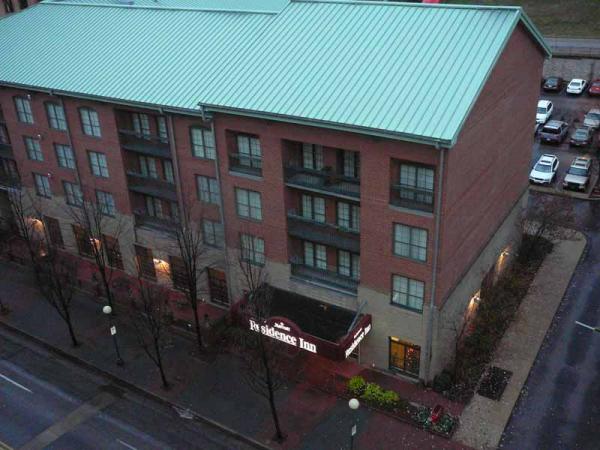
A similar style hotel in Downtown Chattanooga, TN. Because of a difference in zoning regulations, this hotel was designed to face the sidewalk with pedestrian-scale interactivity, while also satisfying vehicular parking requirements in the rear of the property.
9. Context-Sensitive Streets

Jacksonville's recent Main Street streetscape project was not designed to accommodate the bicyclist in the area.
Not all growth is good and not all road construction is bad. Despite the limited funds at the city level, new roadway projects will occur in the short term through a variety of city, state, federal, and private funding sources. The key for Jacksonville is to make sure that they are designed to be context sensitive. Historically, roads in Jacksonville have been designed only with the automobile in mind and at the expense of the neighborhoods they penetrate and serve. By pushing for more thoughtful design standards in the short term, we have the ability to make sure that all future projects will be built to be multimodal-friendly and ensure quality-of-life benefits to the surrounding community.

New Orleans' Canal Street is an example of a context-sensitive street designed to safely accommodate several modes of transportation.
10. Rail Planning Coordination between JAXPORT, JTA, COJ, CSX, FEC and NS

JAXPORT's rail capacity plans include the construction of an intermodal terminal along lines that will utilize portions of the same rail corridor JTA would like to see commuter rail operating on.
JTA has plans for a commuter rail line between downtown and Nassau County, including rebuilding the S-Line rail corridor between Springfield and the Jacksonville Regional Transportation Center. Both JAXPORT and CSX are looking into improving its rail capacity along the same freight corridor. In addition, COJ's recently passed mobility plan is expected to generate money for rail capacity improvements along the same corridor over the next decade. In the meantime, the majority of port-related freight involving FEC is shipped by truck on local streets to FEC's Bowden Yard on the Southside. If JTA is successful at rebuilding the S-Line, this corridor could serve as a vital passenger rail link, as well as directly connect FEC with JAXPORT, making it the only port in the Southeast region with direct access to three rail carriers.
Planning now to pool these entity's resources could reduce the cost and time frame of rail improvements for everyone, bringing better economic development to the port and Northside neighborhoods, and a viable mass transit corridor for the entire city.

The S-Line corridor would bring life and economic opportunity back to many Northside neighborhoods including the Springfield Warehouse District, as illustrated above in the COJ Urban Core Vision Plan.
By no means are these the only short-term, long-hanging transportation improvements ideas that will be available for the Alvin Brown administration to take advantage of. This list only suggests a couple of innovate and creative short-term options out there, that by implementing, will immediately benefit Jacksonville's transportation system and possibly save the city money.
Article by Ennis Davis.

Noone
June 21, 2011, 08:03:58 AMEnnis, Nice work.
I'd focus immediately with number 10.
Imagine the coordinated rail effort of these companies in conjunction with the Promised 680' Downtown Public Pier, Baystreet Pier Park, Downtown Jacksonville Tradeport Pier. What a fun project. What an opportunity to engage the community immediately. What an opportunity to showcase our river to the world. What an opportunity to say "Lets get to work in Jacksonville".
What an opportunity to immediately work with an identifiable project with FIND for the next funding cycle. What an opportunity to embrace the Public Trust Doctrine as it relates to our St. Johns River our American Heritage River.
tufsu1
June 21, 2011, 08:19:25 AMnice article...very succinct and on point
Captain Zissou
June 21, 2011, 08:59:14 AMThe first thing I would do is redesign the Transit Center. The metrojax site plan blows the COJ's out of the water. When you see the two side by side, it's a no brainer. I agree that we need to start promoting and advertising the streetcar. The development time of any significant project is 2-5 years minimum. If they started with design work today, they would open their doors for business right as the streetcar was coming online.
JeffreyS
June 21, 2011, 09:05:03 AMNumber 8 is probably the most bang for the buck. My favorite is number 7 integrate the bus system with a free skyway. The overall savings and increase in use would make subleasing the lower platforms and wrap advertising more valuable.
wsansewjs
June 21, 2011, 09:08:56 AMCan I make a really pretty pretty sophisticated report based on this article that can be printed and hand out to everyone? It would be kinda like an annual report format. MetroJacksonville and all the jazz would be included.
Here is one of my example I designed for a mock-up company.
-Josh
PeeJayEss
June 21, 2011, 09:37:16 AMThat would be pretty cool Josh.
I say bang out #7 this afternoon, #5 over the weekend, and then draw up legislation next week incorporating 3 and 4 into existing road maintenance plans. Those seem so obvious and easy to be almost comical. Then spend your time and energy really going after #2 (such a big ticket and important project like that needs to be done well, and hopefully soon) and #10 (to get the big money flowing).
acme54321
June 21, 2011, 10:06:05 AMThe biggest problem with number 2 is what to do with that conference center.
Captain Zissou
June 21, 2011, 10:18:22 AMHow many conferences and conventions do we currently have that could not be absorbed by the Hyatt or another venue on a temporary basis?? What would the economic impact be of a 4 year hiatus on conventions in Jax?? There will be a few years lag between the closure of the current convention center and the opening of a new convention center nearer the core, but I don't think that should be a deterent to moving it from the Prime Osborn.
FayeforCure
June 21, 2011, 10:20:10 AMThank you for including 4. Simple trees, to make sidewalks pedestrian friendly!!
toi
June 21, 2011, 10:52:51 AMNice article. However, I disagree that the way forward in achieving shorter commutes is to focus on planning and building mass transit lines now. Not only is mass transit commuting slower in terms of average commute times, it is expensive to operate, and will reduce other opportunities to invest in keeping older communities vibrant and competitive with newer communities. We are nowhere near the densities that are necessary to support fixed rail transit, and our biggest difficulty with bus transit is that we are so spread out and low-density that funding enough routes for easy movement around the City is not financially feasible. Why would we think that these same challenges would be overcome with fixed rail? Our densest areas of the City are less than 3 units per acre, yet the research I have seen suggests that densities of 8 units per acre is the minimum needed to see a significant switch over from car commutes to mass transit. Mass transit will only be viable where it is faster than getting in the car, barring some massive increase in the cost of car ownership relative to income such that a much greater percentage of people are forced to go without a car. The Skyway is a perfect example of that. It is far faster to get into the car and drive from the Northbank to the Southbank than it is to take the Skyway. Any fixed mass transit system will have some headways (intervals of service) compared to an individual mode of transit (car, pedestrian or bicycle), which has no headway. With higher densities, pedestrian and bicycle modes become more competitive with the car, though not necessarily faster overall.
We could get the greatest bang for our buck by (1) aggressively shaping public policy to support developers seeking to build denser projects in the developed parts of the City, and (2) taking the mobility fees collected over the first several years and directing all of them towards pedestrian and bicycle improvements, including improvements to crosswalks, street trees, and bus shelters, as more eloquently said by Mr. Davis. There are many gaps in our pedestrian network that could be filled with a relatively small amount of money compared to what it costs to build a new road or rail line. The T-U recently reported that roughly 1 in 5 of all transportation-related deaths in Jax were pedestrians, yet I would bet good money that the proportion of pedestrians to cars on our transportation network through the day is far lower than that. We can fix this.
The alternative to spending mobility fees quickly on a variety of pedestrian and bicycle improvements is to put the mobility fees in the bank, in ten separate accounts for each of the ten mobility zones, until there is enough money to build a road or rail improvement, each of which typically amount to more than $5M. There is just not going to be enough money coming out of the Mobility Fee to see any near term road or rail improvements. The funding contemplated for fixed rail in the mobility plan not like what was done in Charlotte or Tampa, where the rail was put in first -- the funding for rail lines and so forth under the mobility plan is simply too speculative to stimulate private investment. Under our new system, the developers pay into the mobility trust fund first, and then hope that by the year 2030, enough funds materialize for the rail or what have you, plus the government determines to fund the substantial operating costs of such an improvement.
As to the relative benefits of sidewalks and bike lanes, these have virtually limitless capacity, compared to a streetcar or fixed rail line, have minimal operating costs, and have the benefit of having zero headway-related delay (waiting for the train, etc.) Instead of trying to collect many millions for capital and operating funds for a streetcar from Riverside to Five Points, for example, how about spending thousands to improve the sidewalk from the Fuller Warren Bridge to Memorial Park? If it were roughly as wide as the northbank riverwalk extension (except where it has to be squeezed down to deal with expensive-to-move obstructions or hostile landowners), that would provide much more in the way of capacity than any streetcar would. Build it smooth enough and wide enough to allow bikes and peds to share, and sign it as part of the riverwalk. That would be cool and cheap.
Captain Zissou
June 21, 2011, 11:23:25 AMThat's interesting. I was under the impression that Riverside was 5 times that. What would you say the density of Riverplace blvd is? I thought it was about 100+ per acre.
Miss Fixit
June 21, 2011, 11:30:46 AMThese posts illustrate how easy it is to skew statistics in a way that supports an argument (no matter what side you're on). Springfield and Riverside are both more dense than 3 units per acre, but the entire westside or northside would not be. Riverplace Boulevard is not really an "area" unto itself;density would be far less for the entire Southbank than for that cluster of condominiums and apartments.
thelakelander
June 21, 2011, 11:32:14 AMMass transit is actually cheaper to construct, operate and maintain than our current method of building roadways and spreading our limited resources too thin. That's how we've gotten into our poor budget situation now.
The style of transportation infrastructure you investment builds the environment around it. If you want density, you invest in the things that stimulate it. If you want sprawl, you make investments in things that stimulate autocentric development (which we've done a great job at since 1950). Rarely to you see density come before pedestrian friendly transportation infrastructure is put into place. The only place I can think of in the last half century is Miami's suburbs (due to land constraints) and its pretty bad for the pedestrian.
Based on history, I believe your assessment is pretty off-base. Viable mass transit isn't built off of an imaginary average density number across the board. Instead it's based on the systems ability to connect people directly to where they want to go. It's also insane to expect that fixed transit should be designed to immediately serve what essentially amounts to a 800 square mile county. For proof, I offer Charlotte's recent 9.6-mile LRT line. That city is less dense than Jacksonville, the LRT line does not take people all over that sprawlbug, yet it does effectively tie in a number of destinations along the particular corridor it is designed to serve. So effective that ridership has already exceeded expectations. The same is true for new systems in St. Louis, Dallas, Houston and Phoenix, all of which are also reaping in economic development and job creation benefits that Jacksonville can only dream of.
Imo, the major benefit of mass transit is economic development and the creation of an environment where you don't have to use a car or sit in traffic for everyday needs. Jacksonville does not have that now and we're already suffering economically because of it. As for auto congestion, you're right. There's nothing you can do to truly relieve auto congestion in my mind, short of calling for a building moratorium (which is counter productive to the goal of transportation investment to help spur economic development).
The skyway is an incomplete fixed system that will greatly benefit from elimination of bus route duplication and future streetcar and commuter rail lines that will penetrate neighborhoods outside of DT. However, with that said, I work on the Northbank. For a trip to the Southbank, its actually more cost and time effective for me to leave my truck in the parking garage and hop on the Skyway. A side benefit is that the walking helps keep me in shape. A more viable transit system will extend these benefits to areas outside of the skyway's limited sphere of influence.
What happens with headways is that you eventually set your schedule according to them. Nevertheless, mass transit is only a part of an integrated transportation system. When everything really starts to work, you'll find yourself using your feet as the preferred mode of transportation more than anything else (again assuming you're the type who finds urban living attractive).
I agree. However, a part of aggressively shaping public policy is changing you your policy addresses transportation investment. The development of a viable mass transit system plays an important role in bringing the private sector to the table.
The mobility fees are set up to actually do this as well as invest in larger projects that have been proven to spur sustainable economic development. In general, to reach the big picture there are several components that have to be improved and integrated with one another. With that in mind, how we handle our mass transit issues should be an equal priority to resolving our land use, roadway, pedestrian and bicycle network issues.
We can and we should. The mobility plan and fee is designed to generate money for pedestrian and bicycle improvements. We need to make sure the pot for them is actually used for these purposes and not shifted to road or transit projects, which happen to have their own funding pots within the plan as well.
The mobility plan and fee is already designed to do what you propose. In addition to money set aside for the pedestrian/bike projects, there is one major roadway or transit priority project for each zone. It is anticipated that enough money will be generated to construct each one over a 10-year period. Once those projects are funded, these steps will be repeated for additional roadway/transit projects within the plan. With that said, since funding will be generated incrementally, there's no reason that improvements concerning these particular priority projects can't happen incrementally. As for as the initial streetcar and commuter rail lines go, when enough money is generated to pay for their planning and design, we should go ahead and take care of these "incremental" steps. Doing so will put us in the position to leverage additional funding opportunities that may arise in the future at the state, federal or private sector level. In the event that this happens, some mobility funds can then be shifted to additional local projects.
No so. There is a 10-year priority project plan and the entire mobility plan and fee will be re-evaluated in five years. Before pissing in the punch bowl too early, let's see what happens over the next five years and take it from there.
All of these projects work in conjunction with one another. It's not an either or situation. In an urban environment, you must plan with a holistic approach and not with tunnel vision. If you ignore one, two or more and only address sidewalk construction, you'll have a pretty nice yet empty and ineffective sidewalk. The same goes for the other modes.
It be cool and it would be cheap. But it wouldn't spur transit oriented development, it wouldn't bring revitalization to neighborhoods like Brooklyn and LaVilla. Not saying it shouldn't happen, because I would love to see it, but I am saying that it needs to be implemented with a holistic approach.
thelakelander
June 21, 2011, 11:34:54 AMExactly. Which is why it makes sense to evaluate these things by corridor and neighborhood as opposed to a citywide level. Realistically speaking all Jax could really use is a decent 5 to 10-mile fixed transit spine that connects several major destinations together. That could mean that some suburban low density areas may not have viable transit options. So be it.
Captain Zissou
June 21, 2011, 11:46:40 AMMiss Fixit
June 21, 2011, 12:31:01 PMFor the record, I believe that Springfield/Eastside/Durkeeville, Riverside/Avondale/Brooklyn, and San Marco/St. Nicholas would all benefit from mass transit including street car and skyway extensions to those areas.
Dashing Dan
June 21, 2011, 01:05:01 PMIn the meantime we would benefit from more frequent PCT "trolley" service.
thelakelander
June 21, 2011, 01:09:20 PMThe major question would be how would we pay for it? I think the answer would become evident if the entire existing mass transit system was revamped. To this day, I still believe there is a ton of duplication on existing routes that could be modified to allow higher frequencies on others.
Dashing Dan
June 21, 2011, 01:26:12 PMI agree that our existing transit services are spread way too thin. Every council member tries to grab as much transit service as he or she can get for his or her district. Each district gets some transit, so no district gets very much.
If our new council members are advised to come in with more reasonable expectations, that might help.
toi
June 21, 2011, 01:37:18 PMLakelander -- Of the $444M in improvements preliminarily identified for funding under the mobility plan, about 11 percent of the total funds are for bike and ped. I am suggesting that we spend what we collect over the next few years on the bike and ped improvements in all 10 of the zones - front end load them -- rather than putting 89% in the bank for a long time and spending 11% on bike and ped as it trickles in over 19 yrs. I would think that constructing $10 Million worth of the highest priority bike and ped improvements over the next few years would make a big difference throughout the City. As to incremental improvements to roads or streetcar lines, the improvements identified in the plan could not be done smaller than they were already identified without creating the Skyway problem that you described. Maybe we have different expectations as to the amount of funds the City will collect over the first few years. It would be real nice for the proponents of the mobility fee to be able to point to something on the ground in 2013 and say, the mobility fee paid for this.
thelakelander
June 21, 2011, 02:38:54 PMFYI, a significant amount of bike/ped projects connectivity projects will also be funded through mobility plan roadway projects. As mentioned earlier, all of the projects listed in the plan for various modes are highly integrated.
The downfall is, if you do ped/bike projects with no regard to land use integration and how they connect/work with other modes, you'll have a connected system but a poorly used one. That should be something we all want to avoid.
By incremental, in regards to the streetcar and commuter rail projects, I mean planning and design. There's no reason to wait ten years for this phase, once the money becomes available. My guess is once you complete that process and actually have a solid idea of what you're going to build and how its going to operate, a few of these projects will come in well below the current estimated price (ex. streetcar should be able to be built for less than $10 million/mile. The mobility plan sets aside $14 million/mile). Once these numbers are solid and a real plan is in place, we may have the opportunity to shift funds to other needs.
My general view is more of a five year window. However, I think we'll have an opportunity to see some success in the early years and it may involve bike/ped projects like the plan's ped overpass over the Arlington Expressway or bike lanes in the urban core via the resurfacing and restripping of existing streets. If we can committ to the mass transit starter lines, I think we'll have an opportunity to see some major TOD break ground before those actual projects get anywhere close to coming out of the ground.
wsansewjs
June 21, 2011, 11:57:51 PMCome on! Don't throw money at improving pedestrian / bike infrastructure until you bring the actual people through the working and effective public transit.
The people of Jacksonville are STILL addicted to cars. You got to give them a smooth transition of what their car offers to what the new, improved public transit can offer. When that is possible, then people can start jumping from the car bandwagon to the public transit and start to occupy the pedestrian and bike.
When that happen, the pedestrian death rate will decline, the economic impact on the area would increase, and everyone would be happy!
-Josh
Dashing Dan
June 22, 2011, 10:23:44 AMUnlike other municipal services like electricity and water, transit services do not come directly into your house.
For transit service to be utilized, people have to be able to walk or bike conveniently to transit stops or stations. That won't happen unless bicycle and pedestrian improvements happen first.
thelakelander
June 22, 2011, 11:18:33 AMI'd still say that everything needs to have equal priority and improved simultaneously. That's basically the core of what Complete Streets Policies and Context Sensitive Solutions are. With that said, looking at the city as a whole, in some areas the ped and bike network may be fine but transit sucks. In others, there may be transit but a lack of ped and bike connectivity. The only way to truly change is apply these complete streets/context sensitve strategies to a large scale area, while understanding that the specific mobility improvement needed at the end could vary depending on the context of the surrounding environment. The only way you do this is to apply the simultaneous approach.
wsansewjs
June 22, 2011, 11:23:14 AMSo my understanding and translation of your statement...
Complete Streets Policies and Content Sensitive Solutions = Consistency.
Am I correct?
-Josh
Dashing Dan
June 22, 2011, 11:28:49 AMJacksonville Beach is a good example of how pedestrian and bicycle connectivity can work, even when transit is so-so.
The other way around does not work that well.
thelakelander
June 22, 2011, 11:57:31 AMIt works well east of 3rd Street due to the context. Its not as good west of 3rd. I think Jax Beach is a great example of why things should be done simultaneously. It could be so much more than what it is today with thoughtful design and planning.
Dashing Dan
June 22, 2011, 04:08:06 PMSome parts of Jacksonville Beach are very connected and walkable, as are some parts of Jacksonville. That's not my point.
My point is that you don't need good transit in order to have good pedestrian and bicycle facilities, but that you do need good pedestrian and bicycle facilities in order to have good transit.
Agree? or Disagree?
thelakelander
June 22, 2011, 04:42:59 PMI definitely agree. However, that's not the point of the Mobility Plan or the reasoning for the priority projects in it, which is what this particular discussion in generally revolved around (at least from my understanding).
Just to refresh everyone's thinking, here is the original purpose and intent of the mobility plan:
1. Mitigate and/or retrofit suburban sprawl development patterns.
2. Opportunity to consider place-based mobility strategies (diversity, scale, physical assets and character of Jacksonville's unique neighborhoods).
3. Incorporating the guiding principles and themes of Planning District Vision Plans.
4. Objectives of the 2030 Mobility Plan:
A. Support a variety of transportation modes;
B. Reduce vehicle miles traveled;
C. Reduce greenhouse gas emissions;
D. Promote a compact and interconnected land development form;
E. Improve the health and quality of life for Jacksonville residents.
With all of this in mind, from my understanding, even Jax Beach has jumped on the mobility plan bandwagon and have their own in the works.
ralpho37
June 22, 2011, 06:03:06 PMMay I ask, in MJ's JRTC alternative plan, where is the Prime Osborn Center? Unless I'm reading the plans wrong, it looks like the old terminal is just gone. With that configuration, how is everything supposed to fit around the Prime Osborn Center?
acme54321
June 22, 2011, 06:08:29 PMThe convention center is moved for the MJ plan.
Charles Hunter
June 22, 2011, 10:35:04 PMAnd the old terminal building is preserved and returned to its original purpose as a transportation center. Much of the convention center building in back appears to be gone.
Dashing Dan
June 23, 2011, 09:02:14 AMthelakelander
June 23, 2011, 09:38:11 AMAgain, let's go back and review the purpose and intent of the plan:
To achieve the goals of the plan, every neighborhood, corridor and project must be analyzed on a case-by-case basis. When you approach this from a holistic view, you'll find financial opportunities to integrate selected priority bike/ped projects within the confines of roadway/transit improvements. For example, if things were done the way you've suggested (ignore transit/roadway and only focus on ped/bike), money would be spent to add sidewalks and bike facilities to long stretches of Philips and Southside, two major arterial on the Southside that pretty much lack these amenities. These also happen to be corridors where BRT has been proposed and roadway widening is needed. By ignoring transit and road improvements for the favor of sidewalk/bike only, when those BRT and roadway projects come on line, we'd be ripping up the new sidewalks and bike facilities that were added a few years earlier and rebuilding them as a part of each project. I don't know about you, but I'd consider ripping up and building the same sidewalk every two or three years waste of money and extreme fiscal irresponsibility.
Instead of this, money provided for the widening of these roads funds the rebuilding of them into urban cross sections complete with new sidewalks, bike lanes, intersection improvements and capacity enhancements that make it easier for BRT service to be operated on them (ex. "complete streets"). So in essence, pedestrian, bicycle, transit and auto modes have all been addressed in these corridors with auto money. This is especially important for a corridor like Philips where the community's vision is to see it lined with TOD from the proposed parallel commuter rail line.
Philips Highway today. The road money used to widen this section funded by the plan, also pays for sidewalks, bike lanes, intersection and median improvements that will facilitate bike/ped and transit modes as well.
Furthermore, by combining bike/ped needs with auto/transit projects, the money in the plan actually set aside for bike/ped projects can (and is intended) be used to fill in gaps within the bike/ped network on facilities that will not see transit/roadway improvements. Also, what makes anyone believe the money set aside for bike/ped projects won't be spent improving them in the short term? From my understanding, nowhere in the plan is that mentioned. That position sounds more like a knee jerk reaction at this point to something where full understanding of how this thing actually works may still not be clear.
Julia Street in downtown. Sidewalks are already in place, a transit center is a block away and the entrance to FSCJ is across the street. By changing roadway design policy, all you need is some paint to add bike lanes. That could be done with bike/ped money in the plan or simple coordination with public works.
Last but not least, there's a real opportunity at hand to modify policies of how we current design or transportation infrastructure to improve the bike network. The majority of streets within downtown and the city's urban neighborhoods are clearly wider (inside curb to inside curb) than they need to be for automobile travel. These are all streets that COJ Public Works, FDOT, etc. have to maintain and resurface every couple of years. By simple coordination, needed bike connectivity projects in the core city can be implemented in conjunction with non-mobility plan money already set aside for street maintenance. For example, when COJ resurfaces a street like Hubbard in Springfield, why not narrow auto lane widths to make way for bike lanes? This can be done with money where already spending, yet still advance the overall goal of citywide multimodal connectivity. Hopefully, this helps explain why a holistic approach that simultaneously addresses a mobility issues makes more sense then favoring one mode over another.
Dashing Dan
June 23, 2011, 10:46:04 AMSo let me reword my previous question: Are there any transit projects in the mobility plan where bicycle and/or pedestrian accessibility requirements have not been previously (or simultaneously) addressed?
A yes or a no should be sufficient.
thelakelander
June 23, 2011, 12:22:27 PMYes.
Dashing Dan
June 23, 2011, 12:39:33 PMtoo bad
wsansewjs
June 23, 2011, 12:46:02 PMWhy don't we add all of the bicycle/pedestrian accessibility requirements under the handicapped/ADA accessibility. Really, the majority of the ADA / handicapped accessibility requirements share the similar points.
Only the difference is the ADA / handicapped accessibility requirements takes the higher priority so why not let the bike/pedestrians ride on that?
-Josh
thelakelander
June 23, 2011, 01:46:47 PMNow getting back to the office and seeing this online instead of my phone, I guess I'm confused about what you're asking. All I can say is that every project in the mobility plan is intended to be seamlessly integrated with all modes of mobility and land use. In addition, the auto/transit priority projects are independent of the bike/ped when it comes to funding mechanisms. Plus when it comes to the transit and auto priority projects, elements of their designs will also address their connectivity with bike/ped modes (ex. Philips Highway example).
thelakelander
June 23, 2011, 01:51:08 PMADA/accessibility requirements (ramp slope, min. sidewalk width, etc.) will have to be implemented regardless of the project. That's the law. The key for Jax is going to be to go above and beyond the minimum required design standards and regulations.
wsansewjs
June 23, 2011, 02:05:32 PMThat is correct, Ennis. My point is to use the thunder of the federally mandated ADA/accessibility requirements to get those pedestrians / bike accessibility requirements into fruition.
-Josh
Dashing Dan
June 23, 2011, 02:20:03 PMIt would also help if the city had a complete streets policy that applied to transit projects along with road projects. I'm already working on that.
thelakelander
June 23, 2011, 02:20:20 PMI guess I'm lost. Are we talking about new bike/ped projects in the mobility plan or bike/ped issues in general? I ask because the requirements are now law, the city can't legally build new facilities without them. This means all bike/ped projects in the plan will include at least minimal federally mandated requirements.
thelakelander
June 23, 2011, 02:21:50 PMGreat point. It would be nice to have a complete streets policy in effect that would apply to transportation projects across the board. If we did, JTA would have to include a ped/bike overpass over I-95 for their 95/JTB interchange project.
Dashing Dan
June 23, 2011, 02:39:31 PMWe might need to start small, like with a resolution of intent that the city could adopt. But I definitely think that we are onto something! At one of the stops on the Pub Crawl, maybe we could talk about it some more.
thelakelander
June 23, 2011, 06:38:45 PMThere's a good chance I'll be going out of town tomorrow night, so I'm not sure I'm going to be able to make this month's crawl. Nevertheless, we'll definitely need to get together. In the meantime, I just come across this conversion of an existing street in DT Clearwater into a bikeway. Historically, the freight tracks ran down the center with an auto lane on each side. The context sensitive streets approach used replaced one of the auto travel lanes.
http://forum.skyscraperpage.com/showthread.php?t=191618
Dashing Dan
June 23, 2011, 07:33:00 PMI am planning to be at the transportation transition meeting tomorrow.
As a planner I like those images but as a cyclist I find them a little frightening.
Ralph W
June 23, 2011, 08:31:49 PMThe train WILL stay on its side of the line. You just have to make sure you stay on your side.
Ocklawaha
June 23, 2011, 09:35:12 PMCentral Florida
JACKSONVILLE... ANY QUESTIONS?
OCKLAWAHA
duvaldude08
June 24, 2011, 01:09:18 AMFrom some reason we got away from the walkways. The ones that we do have area old as hell and unattractive. They are underutilized as well.
thelakelander
June 24, 2011, 06:04:43 AMThey are underutilized because they were not designed with mass transit, network connectivity and land use integration in mind. No matter what the mode is, its never a good idea to plop something in place without properly thinking about the surrounding environment.
Dashing Dan
June 24, 2011, 10:03:26 AMAmen to that!
malseedj
July 23, 2011, 11:17:57 PMLess than 100 people use the AMTRAK to visit or depart from Jacksonville on a daily basis. Restoring the Palmetto train and extending it from its current terminus in Savannah may add another 30 passengers per day. I have checked the passenger figures at all stations from DC to Jacksonville and the future of transportation does not lie in AMTRAK.
We can move the Existing Grayhound Bus Terminal next to the existing AMTRAK station and integrate their services. All the plans for development of a commuter rail system in Jacksonville overlook a basic issue. There is very little track time available currently for freight. Passenger Rail is a losing venture for railroads. Who is going to pay for the availability of track?
Mr. Davis makes some interesting suggestions but the AMTRAK move back to the Prime Osborne is an example of Vision based on lack of reality.
thelakelander
July 24, 2011, 12:04:57 AMmalseedj, welcome to the forums. He's my response to the points you've raised concerning my advocation of passenger rail as an economic catalyst in the future of Jacksonville. Hopefully, this will clear up any misunderstanding of what's in play locally.
The future of transportation does not lie on any one particular mode. However, all of our modes should be well interconnected with each other and planned in a manner that promotes sustainability, cost efficiency and economic development. Time has proven that intermodal transportation centers play a huge role in achieving proper urban connectivity.
What would be the point in moving another mode of our transportation network to an out-of-the-way isolated location? What type of economic benefit can be expected by further thining out the population density on the streets of downtown? How would such a move spur TOD in the area around the public investment?
With any topic, passenger rail included, one must properly evaluate each corridor on an individual basis. For example, the CSX A line will see a significant reduction in freight use, due to Governor Scott's decision to approve Sunrail. The lion's share of freight traffic will be relocated to the CSX S line.
This map clearly shows the rerouting of freight traffic in yellow and the affect it will have on Jacksonville. Most of the freight trains will head due west from Jacksonville, instead of the current route south on the A-Line. This will reduce the amount of freight trains scheduled to travel along Roosevelt Blvd and into Orange Park. The 61 mile segment being purchased by the State of Florida is highlighted in blue.
In short, because of Orlando's Sunrail project, Jacksonville has the opportunity to benefit from increased capacity from a reduction of future freight traffic on the rail line paralleling Roosevelt Blvd between DT Jax and Clay County. For addition background, feel free to read this link:
http://www.metrojacksonville.com/article/2006-aug-central-florida-commuter-rail-deal-may-help-jacksonville
City owned S-Line ROW between DT Jacksonville and Gateway Mall.
Second, let's address the S-Line between DT Jacksonville and the Northside. Track along this corridor was pulled up years ago and now the right-of-way is owned by the City of Jacksonville. The 2030 Mobility Plan and Fee is expected to generate the funding needed to bring this corridor back to life, which will be instrumental in helping bring redevelopment, revitalization and job creation to the Northside. A side benefit would be the city actually leasing this ROW to a short line railroad, which could then utilize it to connect JAXPORT with FEC's Bowden Yard. Such a move would take trucks off the city's streets and generate revenue needed to substain passenger rail operations. For more background on the S-Line, here are a few links to visit:
http://www.metrojacksonville.com/article/2007-feb-move-over-billion-dollar-bus-its-s-line-time
http://www.metrojacksonville.com/article/2007-feb-rebuilding-the-northside-saving-the-s-line
http://www.metrojacksonville.com/article/2008-apr-csx-jaxport-plan-opens-the-door-for-commuter-rail
CSX's proposed Springfield bypass in Nassau County would divert JAXPORT contain trains around Jacksonville instead of through it.
Third, let's address JAXPORT's rail situation. The plan here calls for CSX to invest some of their profits from selling their Orlando line in creating a new belt railway north of Jacksonville that would reroute port trains away from the city. As in the CSX A line situation, this means increased capacity on the existing rail line paralleling North Main Street, south of I-295/9A. Here is a link to provide you with a little background on this situation:
http://www.metrojacksonville.com/article/2008-apr-csx-jaxport-plan-opens-the-door-for-commuter-rail
FEC and Amtrak working together to return passenger rail back to the East Coast would suggest that some private companies are willing to allow passenger rail operations on their right-of-way.
Now let's address the last proposed commuter rail line, which is the FEC between DT Jax and St. Augustine. Ironically, FEC has been the one railroad in town that has been very open to allowing passenger rail on its tracks. Not only in Jax but also in South Florida. In addition, if the State and Amtrak is successful in gaining funding to return intercity rail to Florida's East Coast, infrastructure would be upgraded to increase capacity needed for both freight and passenger service. Here are a few links to provide you some background with this particular situation:
http://www.metrojacksonville.com/article/2010-dec-fdot-proposing-118-million-for-amtrakfec-project
You may not personally like the concept of passenger rail but that does not mean what's being planned and discussed lacks reality. Without statistical data backing the assumption, the suggestion that there is no capacity or that extra capacity can't be created is simply a personal opinion not based on fact. Hopefully, the links and information provided in them helps illustrate that what is being advocated didn't just fall off the back of turnip truck.