
9 Reasons to Expand the Skyway as a Streetcar
November 23, 2015 8 comments Print Article
Like it, love it or hate it, it's decision time concerning what to do with the Skyway's future. Here's 9 reasons why the Skyway should be converted into a lightweight streetcar.
6. Maintenance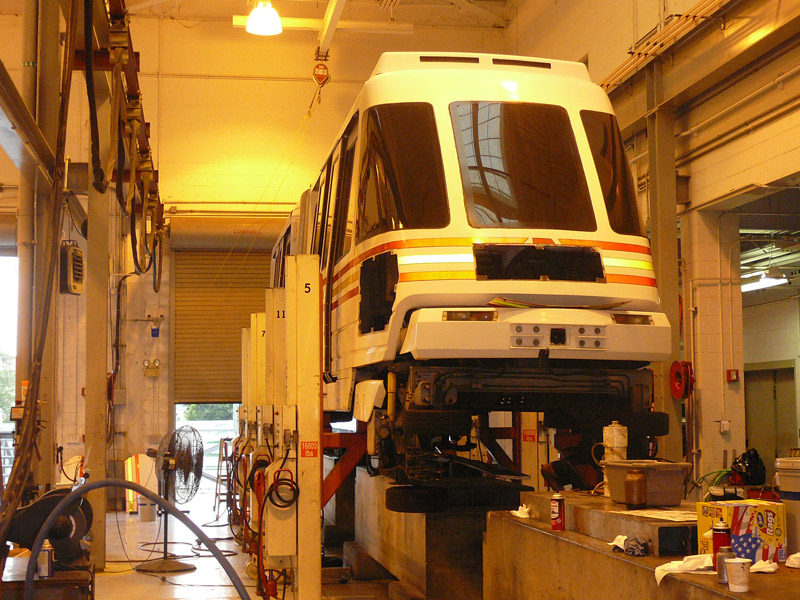
An obsolete Skyway vehicle in need of repair inside the Skyway's O&M center.
There was a reason the Skyway was only one of three APM systems developed as urban circulators during the 1980s. It was quickly determined that there were more cost effective transit solutions available for cities. Today, the Skyway's unique operating system and vehicles are on their last legs and obsolete, resulting in high Operations and Maintenance costs.
Since the 1989 opening of the JTA Skyway, no American city has built an APM to serve as an urban circulator. Why stick with an expensive transit technology with high maintenance costs that can't be largely expanded beyond its current length ifsomething else more cost effective is available?
Six cities (Charlotte, Tampa, Little Rock, Memphis, Kenosha, Dallas) have built new heritage systems since the initial construction of the Skyway. Several others (Philadelphia, Boston, San Francisco, New Orleans) continue to operate heritage vehicles on original early 20th century streetcar lines. A host of other cities, like Savannah, Fort Collins and Los Angeles operate small heritage lines for tourism purposes.
A PCC streetcar undergoing restoration at the Brookville Equipment Company Plant.
US manufacturers that build replica or restore vintage streetcars include Gomaco Trolley Company, Brooksville Equipment Company, and TIG/m. What this means is that there is industry infrastructure in place, reducing cost of vehicles, parts, maintenance and labor that is not available for the existing Skyway APM vehicles.
7. Higher Ridership
St. Vincent's Medical Center in Riverside is one of several transit ridership generating anchors within close proximity of Downtown that the Skyway will never reach if it remains an Automated People Mover (APM).
This one should not be too difficult to explain. The Skyway is currently one of the JTA's most successful routes, averaging 5,000 riders each weekday, despite being only 2.5 miles in length and only serving Downtown. The major detriment to continued ridership growth is the lack of connectivity with a decent number of pedestrian-friendly destinations or direct access to major event sites and employment centers with limited parking. Modest expansion to nearby areas such as the Sports Complex, Five Points, St. Vincent's, UF Health Jacksonville, Riverside Avenue, Park & King, San Marco Square, Springfield, Jacksonville Farmers Market, etc. resolves this issue. Switching to vehicles that allow cost-efficient expansion outside of Downtown to places where people currently live, work and play results in higher ridership. Higher transit ridership in these areas, means more privately owned land can be utilized to accommodate new economic development opportunities, as opposed to vibrancy-killing surface parking lots.
The key to ultimately solving the Skyway's problems is to expand the system to tie Downtown with surrounding neighborhoods and districts like Springfield.
8 Comments so far
Jump into the conversation