Tale of the Tape:
Indianapolis Pop. 2007: 795,458 (City); 1,715,459 (Metro-2008) - (incorporated in 1821)
Jacksonville Pop. 2007: 805,605 (City); 1,313,228 (Metro-2008) - (incorporated in 1832)
City population 1950: Jacksonville (204,517); Indianapolis (427,123)
Consolidated with County:
Indianapolis: 1970
Jacksonville: 1968
Metropolitan Area Growth rate (2000-2008)
Indianapolis: +12.48%
Jacksonville: +16.97%
Urban Area Population (2000 census)
Indianapolis: 1,218,919 (ranked 33 nationwide)
Jacksonville: 882,295 (ranked 43 nationwide)
Urban Area Population Density (2000 census)
Indianapolis: 2,204.5
Jacksonville: 2,149.2
City Population Growth from 2000 to 2007
Indianapolis: +13,588
Jacksonville: +69,988
Convention Center Exhibition Space:

Indianapolis: Indiana Convention Center (1972) - 566,600 square feet after current expansion project is complete
Jacksonville: Prime F. Osborn III Convention Center (1986) - 78,500 square feet
Attached to Convention Center:
Indianapolis: physically connected via skywalks to 12 hotels 4,700 hotel rooms system.
Jacksonville: N/A
Tallest Building:

Indianapolis: Chase Tower - 830 feet
Jacksonville: Bank of America Tower - 617 feet
Downtown Fortune 500 companies:
Indianapolis: Well Point (32), Eli Lilly (122), Macy's (96), Brightpoint (496)
Jacksonville: CSX (240)
Urban infill obstacles:
Indianapolis: Separated from the city's urban neighborhoods by surface parking lots.
Jacksonville: State & Union Streets cut off Downtown Jacksonville from Springfield.
Downtown Nightlife:
Indianapolis: The streets around Circle Centre Mall
Jacksonville: East Bay Street, located between Main Street and Liberty Street. This four block stretch is home to four bars and clubs.
Common Downtown Albatross:
A large number of surface parking lots and underutilized property that cuts downtown off from vibrant inner city neighborhoods.
Who's Downtown is more walkable?
Indianapolis: 100 out of 100 (Downtown Indianapolis as keyword)
Jacksonville: 95 out of 100, according to walkscore.com (Downtown Jacksonville as keyword)
Indianapolis - Jacksonville Scaled Comparison

Jacksonville municipal borders: present (red), pre-consolidated city limits (green)

Jacksonville present (red line) and pre-consolidated city limits (green line) over Indianapolis city limits (red shaded area)
Clarion Health People Mover


Indianapolis Canal Walk
Canal Walk is a linear public space designed around the old Indiana Central Canal. The path features a mix of old and new architecture, attractions, monuments, and a waterside promenade for jogging, inline skating, biking, and boating. Amenities along canal walk include Pedal boat rentals, bike rentals, murals, a waterside cafe, and waterfalls.
Attractions constructed along Canal Walk include the USS Indianapolis Memorial, Congressional Medal of Honor Memorial, Historic Landmarks Foundation, Indiana Government Center, Military Park, Eiteljorg Museum, Indiana State Museum/IMAX and NCAA Hall of Champions.


A directory illustrating the Canal District

Exhibits on the history of the city have been installed under bridges along the Canal Walk


Downtown Indianapolis
Indianapolis was founded in 1820, as the site for Indiana's new state capital. The railroad was extended to the city in 1847 and soon Indianapolis became the home of the first Union Station in the country. As the Midwest boomed during the early 20th century, Indianapolis grew into an auto manufacturing center. By the 1970s and 1980s, the city suffered from urban decay and white flight. During the 1990s, leaders focused on restoring the city's image by concentrating on diversifying the economy and downtown revitalization. Today, the Indianapolis metropolitan area is among the fastest growing in the Midwest.


The headquarters of the Simon Group


The Indianapolis Union Station was the first union station in the world, opening on September 20, 1853. In 1979 the facility was converted from railroad station to festival marketplace by Woollen Molzan & Partners, opening in 1986. The mall closed in 1997, once Circle Centre took all of its customers. Today, it serves as the home to a mix of establishments including a hotel, charter school and an African American museum. Amtrak also still uses the Romanesque Revival structure.

Lucus oil stadium


Monument Circle
Alexander Ralston, an apprentice to French architect Pierre L'Enfant was commissioned to design the new capital city. Ralston's design featured a large circular commons in the center of the city. In 1857 a 284-foot neoclassical monument was constructed in it. Today, this area is known as Monument Circle.


Capitol Building


Circle Centre Mall
Developed by Simon Property Group, which is also headquartered in Downtown Indianapolis, Circle Centre Mall opened to the public on September 8, 1995. The mall has been the centerpiece of the redevelopment of downtown into the vibrant scene witnessed today.
The design itself is a mix of old and new. The 786,000 square foot mall features 100 stores on four levels, Nordstrom, Carson Pirie Scott, GameWorks and a nine-screen United Artists movie theater.
www.simon.com/mall/default.aspx?ID=163


Old & New

Learning from Indianapolis
Despite the vibrancy of Downtown Indianapolis, it is still separated from the city's urban neighborhoods by surface parking lots. As this city continues to strive for urban revitalization, the next piece to the Indianapolis puzzle will be attracting infill development to replace the large surface parking lots.
An important aspect of Indianapolis to take away: Notice what is possible when major urban destinations are located adjacent to each other, with existing historic building fabric left in place, allowing specialty retail and restaurants to open and survive off the traffic that the destinations generate.
The scaled aerials below show it all.
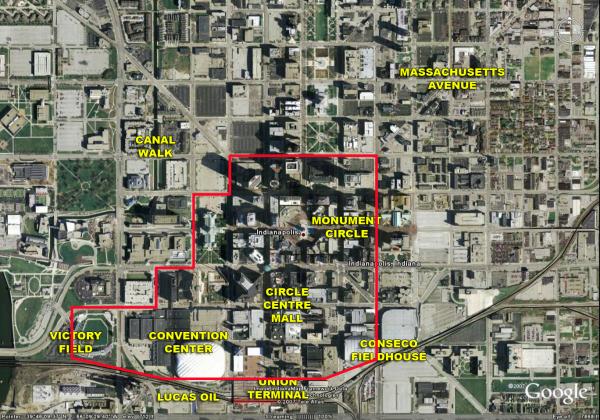
Downtown Indianapolis aerial
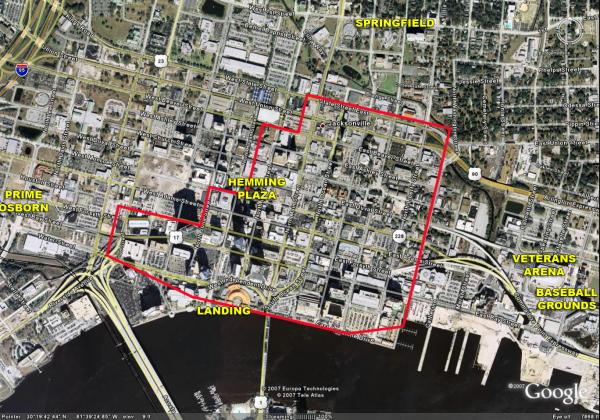
Downtown Jacksonville aerial
Most of Indianapolis' major destinations, if moved to the Northbank, would fit in an area that stretched East/West from Berkman Plaza to Broad Street and North/South from the riverfront to State Street. When overlaying the Indianapolis footprint over the Jacksonville area, the Prime Osborn and Jacksonville Municipal Stadium are so far outside of that area that they can't be seen on the aerial. This should speak volumes for the importance of connectivity and the clustering of urban development.
Related Article:
Roadtrip: Indianapolis
Article by Ennis Davis
Hurricane
July 15, 2009, 07:30:39 AMI grew up just outside of Indy. It isa great city. My regret is that we lived 45 minutes from downtown, so I never really got to experience the true city. I'm surprised that you didn't cover Broad Ripple. They've got about 50 bars within 2 blocks and everyone under 35 lives within walking distance. The Broad Ripple area is awesome!
zoo
July 15, 2009, 07:57:36 AMWhat strikes me is the effective design and management of their park system, including Canal Walk, and the amazing amount of public art (and some of the architecture fits into that category, as well). Last time I visited, to see the result of strong leadership that listens to its citizenry, almost made me pity Jax. Putting the two side by side, Indianapolis would clearly be a more vibrant, effectively-run city with optimized assets and healthy private engagement (corporate).
Two questions related to what I believe are key comparative factors, what are the educational assets in the downtown area, and what is the tax rate?
Were it not for the weather and the beach, I'd move there in a minute...
fsujax
July 15, 2009, 08:08:06 AMWhat strikes me is the stark difference in Downtown activity. How can their Downtown be so vibrant? and ours so dead? I know I am going to get the usual it's FBC's fault, but I think its more than that. Also, I do not believe Indy has any sort of major rail transit...i.e streetcar, LRT or commuter rail. I could be wrong, i am sure I will be corrected if I am. It would be good to do an in depth case study to compare Downtown Indy with Downtown Jax and try to figure out why our Downtown is so far behind. I would like to see someone at MetroJax take this and run with it.
thelakelander
July 15, 2009, 09:16:49 AMBroad Ripple is a nice area. Unfortunately, my time in Indy this go around was pretty limited, so I did not get out to many neighborhoods. However, the 2007 Indianapolis tour did include a little information on Broad Ripple.
http://www.metrojacksonville.com/article/2008-jan-roadtrip-indianapolis
I'll take a stab at it. Three words: Connectivity, Compactivity and Clustering. Downtown Indianapolis has a ton of complementing uses that are directly adjacent to each other. Because of this, its easy for various uses to stimulate pedestrian traffic between each other, which in turn, creates opportunity for complementary accessory uses (restaurants, specialty retail, bars, etc.) to fill in the small gaps, assuming there are buildings for them to go into. From that point, its a snow ball effect, in regards to vibrancy.
For example, if you're in town for a convention or sporting event, within a two or three block radius, there are a number of hotels, restaurants, bars, museums and even a shopping mall. Come in to Jacksonville and that same distance from the convention center or sports complex consists of parking lots, a few isolated buildings and overgrown lots where buildings once stood.
The aerials say it all:
Downtown Indianapolis
Downtown Jacksonville
Going back to Jax, you mentioned FBC. If that area of downtown is to be successful, the city needs to work with FBC to make their buildings and interior uses more integrated with the outdoor environment around them. I'm not familar with the interior uses or their locations within each building, but better integration could include:
- Sidewalk window displays of the church's history or works along sidewalks with dead space.
- Letting the public use the proposed main street recreational park during times when it is not being used by FBC.
- Accomodating limited retail space in the corners of some of the garages. This could generate revenue for the church and put people on the sidewalks in that area.
- Improve the visual quality and appeal of existing retail oriented storefronts, like the Christian Bookstore.
- Relocate church's cafeteria to a location that can be seen from the street, that can also accomodate sidewalk dining.
- Banners or something to soften the hard edge the church's buildings have along Union Street.
- Consider opening the original church building up as a museum during hours when not in use by the church. Its an architectural landmark with a significant past that has helped shaped the downtown environment we have today.
There are a lot of other things that can be done, but the points mentioned above are just a few examples of ways to better integrate the church into the surrounding urban core. Short of relying on major projects, which the city can't afford, similar small projects can be done like this throughout the Northbank which will help stimulate synergy and pedestrian movement between existing uses.
vicupstate
July 15, 2009, 09:17:18 AMPicking up on fsujax's comment, Indy and Jax are closely related to each other in terms of size, consolidation, being a center of business for it's state, smaller-sized NFL market, etc.
I also agree that FBC is a lame, 'crutch' excuse that needs to be put in it's true perspective.
A more in-depth analysis/comparision between the two cities would be interesting, but the gist of it would be this: Jax has not utilized good master planning and good urban design in what it has done. Each project from the Landing to the convention center to the sports complex to the Riverwalks to the Main Street pocket park, have all been as if they are stand alone projects with no thought given to the interactions between projects, the immediate surroundings of each or what the completed 'environment' should be or look like.
I've always considered Indy, Charlotte, Nashville, Orlando, Norfolk and Austin to be the truest 'peer' cities to Jacksonville.
Jason
July 15, 2009, 09:26:52 AMIts amazing how similar the two cities are (by the numbers).
IMO, the only three major advantages Indy has over Jax is that Indy is a state capitol, has much less in state competition from neighboring cities, and has a lot more of its historic building stock intact.
Downtwon Jax has endured a serious string of bad luck since the 60's including white flight, the boom of the burbs, and the explosive growth in Central and South Florida providing some seriously stiff competition. Despite all that has pulled against this city, we are still a major metropolitan area with a steady growth rate and a strong diverse economy. IMO, Indy looks today like Jax will look in 7-10 years.
thelakelander
July 15, 2009, 09:27:18 AM^I agree, Vic. All of those places have more vibrant downtowns because thought has been given to how individual projects interact with their immediate surroundings (ie. connectivity). When we carry out a good plan that embraces urban design, the amount of money we spend on implementing it won't matter. The largest visual change will come from the placement and outward design of those uses so that they have a positive impact on the immediate environment around them.
thelakelander
July 15, 2009, 09:33:42 AMIMO, the only three major advantages Indy has over Jax is that Indy is a state capitol, has much less in state competition from neighboring cities, and has a lot more of its historic building stock intact.
On the other hand, Jax has a major port, less regional competition (Chicago, Cincinnati, Dayton, Louisville all around 2 hours away), a major river downtown and a beach. We just have to better utilize our assets.
The funny thing is, just about every city Jacksonville's size has had to deal with the exact same issues. We've also spent just as much money in our core over the years as they have. The major difference being what Vic pointed out. Our projects not being design to fit in with their immediate surroundings. No matter how much money we spend, if we don't follow a good urban master plan or strategy, things will remain the same.
heights unknown
July 15, 2009, 10:38:26 AMThough Indianapolis seems to be a bit more successful and prosperous, both these cities have more in common than it appears, and it's almost like looking at parallel mirror cities. Both are consolidated cities, consolidated at about the same time, and I can't help but wonder which City has been more successful with consolidation. Does anyone know whether the 830 feet for their tallest building includes those antennaes? Nice looking city and the downtown seems more filled and dense than ours.
Heights Unknown
heights unknown
July 15, 2009, 10:43:25 AMI agree wholeheartedly Lakelander, and, this is why, in my opinion, it is very important that our City Government and Leadership take a very close look at the area where the Courthouse is being constructed, and make smart and impactful use of the so called outward design and urban surrounding design for that area in order to take full advantage of the existence of the Courthouse and other viable projects in that area. We have pretty much "dropped the ball" on most of the rest of downtown, but let's try and "get it right" with the Courthouse project and the surrounding area.
Heights Unknown
thelakelander
July 15, 2009, 10:45:50 AMWith the twin spires, the Chase Tower is 830 feet. Without them, the actual tower is 700 feet.
fsujax
July 15, 2009, 11:13:37 AMLake great ideas about how to get FBC involved. It's nice to see constructive ideas, rather than bashing. I still would like to see an attempt to really investigate this further. We have got to get Downtown on the ball.
vicupstate
July 15, 2009, 12:19:52 PMOne thing that the pictures don't truly reveal, is the dominance of the monument in Monument Circle and the Circle itself to DT. You kinda have to see that in person to really appreciate it's scale and distinction. It's kind of surprising that the Capitol is not the centerpiece of the city. That is more typical of state capitals.
The American Legion also has it's office in INdy and there are major war memorials too with expansive lawns connecting all of those things. It is sort of a mini-mall a la Washington DC. Definitely worth seeing if you go there.
Deuce
July 15, 2009, 12:52:47 PMAh, my birthplace. Great article once again!
JaxNative68
July 15, 2009, 04:53:10 PMIn my opinion this has been the most poignant comparison yet.
"The scaled aerials below show it all" is a very telling graphic.
What stands out most to me on the aerials is density. The City of Jacksonville needs to create better incentives for business and people to move back downtown. If you can get the businesses to move back the people will follow along with retail.
I really like the similarities that could be: Canal Walk - Jax's forgotten canal and Circle Centre Mall - Jax Landing.
With a lot of creative infill, Jacksonville's downtown could easily be as successful as Indy's, but three fold in size. With our river, beaches and better climate (ignoring this past month's rain) Jacksonville would be much more enticing than Indy. Just invite everyone down here in the Fall, our weather will have them packing their bags up north. Now if we can only get the Jags to overcome the Colts in the playoffs!
brainstormer
July 15, 2009, 04:54:30 PMExcellent discussion so far! I really think connectivity is one of the key issues why our downtown doesn't look like Indy. We have some of the same venues plus we have the river, yet still we can't seem to get it right. Imagine if Memorial Arena had been built within walking distance of the Landing and Bay Street? Right there Jax could have had one more thing inside Lake's red box (I love the overlay by the way!).
Looking ahead, a new convention center has to happen and the old courthouse site is the key spot. Because of many of the bad choices we have made in the past, fixed mass transit such as streetcars is also a must to help compensate for some of our spread out venues. I like the above ideas about FBC and there are a lot of other small ideas we can come up with. Unfortunately, it takes big ideas like arenas, convention centers and malls, to bring in the people and the small businesses won't survive until the people come.
Other noticings include outdoor sidewalk seating and many public statues, fountains and interesting artwork. I also think their downtown signage really adds flavor and fun to the area. Look at the huge, red vertical parking sign, the vertical Borders sign, the Grill with an actual grill on top of the sign, Bob's neon palm tree and Hard Rock signs that stick out over the sidewalk, Alcatraz Brewing Company's entrance, and the various clocks and colorful banners on the sides of windowless buildings. All of the color and art creates a fun vibe to walking around downtown. Our downtown businesses are severely lacking in this department! We need to encourage more of this.
Keith-N-Jax
July 15, 2009, 08:09:00 PMI visited Indy in 07, they love their Colts. Blue and white with horse shoe is everywhere. I liked their downtown its smallish like ours, but appears to be more dense and with activity. The only time you will see a fair amount of activity downtown its has to be an event or holiday. The city nor most residents dont embrace our downtown. Downtown is suppose to be like your living room where you put your best funiture. IMO with our river, bridges, port, and certainly our weather we should be there already. The 10 to 20 yrs and will be there has gotton old now. Its time for citizens to start holding city leaders accountable for their actions.
Overstreet
July 16, 2009, 10:55:06 AMI grew up in the burbs of Indy. I rarely recognize that area now. The suburbs have changed too. Most for the worst. Seems folks have moved farther out. Some is the kids grow up, get jobs, and move out of their parents house. They then buy houses farther out and the old neighborhoods decay.
The transition of downtown started 30 years ago in Indy. It takes time. One reason so many buildings down town are connected is the weather. It gets real cold and sloppy in the winter. All that pretty white snow in pictures turns to brown slush on city streets. Before they started the push down town it emptied much like Jacksonville. However there was always the activity of the state government offices, capital, etc.
The Soldiers and Sailors monument in Monument Circle downtown was originally the site of the Governor’s residence. But one of the governor’s wives did not like the fact that her laundry was hanging outside for all to see and the residence was moved. The fountains were often the brunt of pranksters that would either put dish detergent or dye markers in the water turning the water into suds or antifreeze colored water.
The thing though is I can go to Indy. See a race, go to a play, visit a park, visit a museum, eat in some fine restaurants and never need to go downtown. Not all that is to be seen or do in Indianapolis is in downtown.
thelakelander
July 16, 2009, 11:15:40 AM^Good point. Despite being able to go see a race, play, visit a park, museum, and eat outside of downtown Indy, the core is still compact and vibrant. The same can happen in Jacksonville. You say Indy's conversion has been a 30 year process. Well the DT Jax you see today is the result of a 40 year process of not placing a priority on how individual projects integrate with their surrounding environments.
Imo, we don't have to go 30 years to turn around things. Doing that makes our redevelopment process actually stretch out to 70. When we take a close look, its easy to see the Jax has a lot of development already in place to serve as the cornerstones for a vibrant district. Our issue will be finding a way to better utilize, connect and integrate them with one another. If we can embrace this issue and properly attack it, change for the better will happen rapidly.
JaxNative68
July 16, 2009, 11:24:41 AMdefinately better connectivity will help these area grow and eventually become one. Why do most threads on this site circle back to the street car?
JaxNative68
July 16, 2009, 11:26:44 AMto the above - excuse my spelling, sometimes fast typing isn't my friend, and I'm not intelligent enough to use the spell check.
thelakelander
July 16, 2009, 11:36:56 AMMy guess is because its the one thing that, if re-established, can trigger rapid progress on many of the issues we consider important locally. Those issues include downtown vibrancy, reducing sprawl, encouraging sustainable development, redeveloping inner city neighborhoods, attracting quality infill economic development, reducing crime in blighted areas, enhancing regional mobility, improving mass transit, education (indirectly through urban infill and corporate relocations).
JaxNative68
July 16, 2009, 12:12:26 PMIf there were quality mass transit connecting the beach to downtown, I would definitely ride it to work every day that was feasible (days without meeting around town).
stephendare
July 16, 2009, 12:19:49 PMAs a proud former resident of Muncie Indiana, I love seeing this article, Lake.
My former business partner, Scott Forgey and I had to file all of the new bankruptcy petitions in the Indy federal courts and so we ended up making the drive at least once a week for four years of the practice with boxes of paperwork.
Several of our business associates had various interests in the Circle Center redevelopment projects (since it involved most of the old families in the entire state) And while the City began the process thrty years ago, most of it was set in place and done by 10 years ago.
The only reason it took so long was the politics behind the real estate and ownership of the downtown properties. Several of the big players actually ended up getting crushed before the project could go through, and a lot of quiet blood was spilled in the financial and business worlds of Indiana to make that happen.
Once the build out began and the structures started getting connected the city threw themselves into the project with typical midwestern thoroughness and industry. It happened quickly. The downtown relaxed parking enforcement to the point where only maniacs were getting parking tickets and then the area began picking right up.
When we were there our favorite place in downtown was actually off michigan avenue, a really awesome coffeehouse venue called The Abbey.
Before I lived in Indiana, by happenstance my sister Nichole moved from Charleston to Indianapolis and lived there for a year or so.
We share a great enthusiasm for the Broad Ripple area, and the coffeehouses and clubs there (especially the vintage days of The Vogue and an awesome place called Eden)
Cheryl and I would frequently take Zorn and the kids to the area on the weekends. It was like a little oasis of city bohemia in the cornfields and factories.
Did you get to spend much time in Broadripple while you were there?
Anyways, Indy is so similar to Jacksonville in terms of dynamics and how things work, that I learned a lot about my hometown by doing business there. It was weird being in a completely different culture where people thought and did things for opposite reasons socially that ended up with the same successes and impasses.
thelakelander
July 16, 2009, 12:25:06 PMI spent some time in Broad Ripple around December 2007. last month, I was only in town for about 2-3 hours, so I spent the entire time walking around downtown.
JaxNative68
July 16, 2009, 12:37:40 PMWhen living in DC I used my feet, the metro, cabs and buses to get around during the week. My car sat in the driveway and was only used on the weekends for getting out of town for entertainment purposes. Not to mention I was probably 25 lbs lighter due to the walking.
When you live in a city that has great connectivity and a vibrant streetscape it is amazing how far you will walk to get somewhere without even thinking about it. This can definitely be said for many thriving metropolises around the county and something I truly miss since moving back to Jax, along with my smaller pants size.
I am hopeful that one day it can be experience here as well.
thelakelander
July 16, 2009, 12:43:47 PMYour point is one that I have noticed while visiting Baltimore, Pittsburgh and Cleveland over the last week. In Jax, State and Union are seen as streets that cut off pedestrian traffic between Downtown and Springfield. In most vibrant major cities, heavily traveled streets like State and Union are normal. Despite this, people still cross them on foot with no problem. The major difference: There's a reason to cross the street and continue walking. There are things on the other side of them instead of parking garages, surface parking lots and vacant plots of land.
brainstormer
July 16, 2009, 03:57:20 PM^We always blame State and Union for cutting off the downtown from Springfield, but I don't think it's those two streets alone. If you think about it, it is over a mile walk from Hemming Plaza to Third and Main with virtually nothing of use in between. If I walk from City Hall, I pass three solid blocks of parking garages and windowless buildings (FBC!), then have to cross two busy 4 lane streets, a vacant lot, more run down buildings, a fenced in park full of goose crap, more vacant lots and used car lots and finally I could stop for some ice cream or a soda. I forgot about Hola!, but I think I've made my point. We can't seem to connect our convention center to a hotel, let alone connect two residential/retail areas (Laura/Adams Street and Springfield). When you factor in the 90 degree weather during the summer, it really isn't surprising.
One of the reasons we push streetcars or skyway extensions is because having fixed transit that connects these areas would be economically beneficial and small businesses would see a boost in revenue by getting away from only serving the small microcosms every part of this city currently operates in. Those of us who hate driving and parking would have an option because right now our option is to just not bother. I can make mac and cheese with much less hassle.
lewyn
July 18, 2009, 11:44:40 PMIs the South Bank part of the problem? Having destinations divided by the river is not exactly an asset.
Keith-N-Jax
July 19, 2009, 11:38:16 PMI cant see having the split Banks a problem when its a very short drive, and the skway connects/ If anything it gives you great views when crossing. The problem with the city is not its seperate banks.